How Families Have Changed Over the Past 50 Years
 Family life is changing. Two-parent households are on the decline in the United States equally divorce, remarriage and cohabitation are on the rise. And families are smaller now, both due to the growth of unmarried-parent households and the drop in fertility. Not merely are Americans having fewer children, simply the circumstances surrounding parenthood have changed. While in the early 1960s babies typically arrived inside a marriage, today fully iv-in-ten births occur to women who are single or living with a not-marital partner. At the same time that family structures have transformed, so has the role of mothers in the workplace – and in the home. As more than moms have entered the labor force, more have go breadwinners – in many cases, primary breadwinners – in their families.
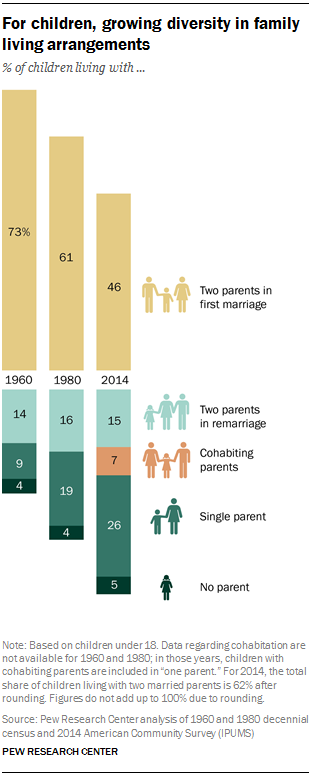
Equally a issue of these changes, at that place is no longer i dominant family unit form in the U.S. Parents today are raising their children against a backdrop of increasingly various and, for many, constantly evolving family forms. Past contrast, in 1960, the height of the mail service-World War Two babe boom, there was ane dominant family class. At that fourth dimension 73% of all children were living in a family unit with two married parents in their first marriage. Past 1980, 61% of children were living in this type of family unit, and today less than half (46%) are. The declining share of children living in what is frequently deemed a "traditional" family unit has been largely supplanted by the rising shares of children living with single or cohabiting parents.
Not but has the diverseness in family living arrangements increased since the early on 1960s, but so has the fluidity of the family. Non-marital cohabitation and divorce, along with the prevalence of remarriage and (not-marital) recoupling in the U.S., make for family structures that in many cases continue to evolve throughout a child'due south life. While in the past a child born to a married couple – every bit most children were – was very probable to grow up in a home with those two parents, this is much less mutual today, as a child'due south living organization changes with each adjustment in the human relationship condition of their parents. For case, one study found that over a three-year period, about three-in-ten (31%) children younger than 6 had experienced a major change in their family or household structure, in the form of parental divorce, separation, matrimony, cohabitation or death.
The growing complexity and diversity of families
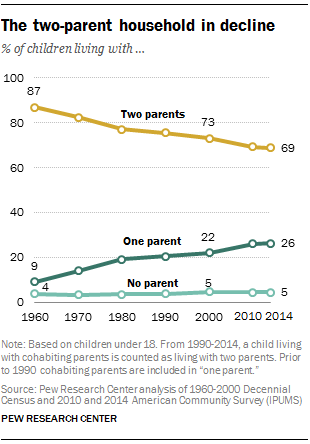 The share of children living in a two-parent household is at the lowest signal in more than than half a century: 69% are in this blazon of family organisation today, compared with 73% in 2000 and 87% in 1960. And even children living with 2 parents are more than likely to be experiencing a diversity of family arrangements due to increases in divorce, remarriage and cohabitation.3 Today, fully 62% of children live with 2 married parents – an best low. Some 15% are living with parents in a remarriage and 7% are living with parents who are cohabiting.4 Conversely, the share of children living with one parent stands at 26%, upwardly from 22% in 2000 and just 9% in 1960.
These changes take been driven in function by the fact that Americans today are exiting wedlock at higher rates than in the past. At present, about 2-thirds (67%) of people younger than 50 who had ever married are still in their beginning spousal relationship. In comparing, that share was 83% in 1960.v And while amidst men about 76% of offset marriages that began in the tardily 1980s were still intact x years later, fully 88% of marriages that began in the late 1950s lasted as long, according to analyses of Demography Bureau information.half dozen
The ascension of unmarried-parent families, and changes in two-parent families
 Despite the decline over the past one-half century in children residing with two parents, a majority of kids are all the same growing up in this type of living system.7 However, less than half—46%—are living with two parents who are both in their outset spousal relationship. This share is downwards from 61% in 19808 and 73% in 1960.
An boosted 15% of children are living with 2 parents, at least ane of whom has been married earlier. This share has remained relatively stable for decades.
In the residual of 2-parent families, the parents are cohabiting merely are non married. Today 7% of children are living with cohabiting parents; however a far larger share will experience this kind of living organisation at some point during their childhood. For example, estimates suggest that about 39% of children will have had a female parent in a cohabiting relationship by the time they turn 12; and by the time they plough 16, almost half (46%) will have feel with their mother cohabiting. In some cases, this will happen because a never-married female parent enters into a cohabiting relationship; in other cases, a mother may enter into a cohabiting relationship after a marital breakup.
The decline in children living in two-parent families has been offset by an almost threefold increase in those living with just 1 parent—typically the female parent.nine Fully one-fourth (26%) of children younger than age eighteen are now living with a single parent, upwardly from just 9% in 1960 and 22% in 2000. The share of children living without either parent stands at five%; nearly of these children are being raised by grandparents.10
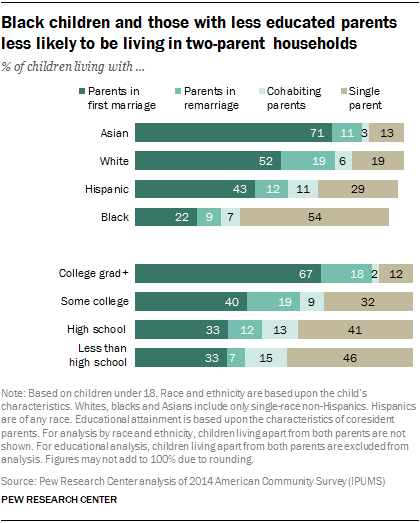
The majority of white, Hispanic and Asian children are living in two-parent households, while less than half of black children are living in this type of arrangement. Furthermore, at least half of Asian and white children are living with two parents both in their first matrimony. The shares of Hispanic and black children living with two parents in their commencement spousal relationship are much lower.
Asian children are the most likely to exist living with both parents—fully 84% are, including 71% who are living with parents who are both in their first marriage. Some 13% of Asian kids are living in a single-parent household, while 11% are living with remarried parents, and just 3% are living with parents who are cohabiting.
Roughly viii-in-x (78%) white children are living with 2 parents, including about half (52%) with parents who are both in their beginning union and xix% with two parents in a remarriage; half dozen% have parents who are cohabiting. Most 1-in-five (19%) white children are living with a unmarried parent.
Amidst Hispanic children, two-thirds live with ii parents. All told, 43% live with two parents in their first marriage, while 12% are living with parents in a remarriage, and 11% are living with parents who are cohabiting. Some 29% of Hispanic children alive with a single parent.
The living arrangements of black children stand in stark dissimilarity to the other major racial and ethnic groups. The majority – 54% – are living with a unmarried parent. Simply 38% are living with two parents, including 22% who are living with two parents who are both in their first matrimony. Some 9% are living with remarried parents, and 7% are residing with parents who are cohabiting.
Children with at to the lowest degree 1 college-educated parent are far more likely to be living in a 2-parent household, and to be living with two parents in a first marriage, than are kids whose parents are less educated.11 Fully 88% of children who have at least one parent with a bachelor's degree or more are living in a 2-parent household, including 67% who are living with ii parents in their first matrimony.
In comparison, some 68% of children who have a parent with some college feel are living in a 2-parent household, and just 40% are living with parents who are both in a first marriage. Near six-in-ten (59%) children who take a parent with a loftier schoolhouse diploma are in a ii-parent household, including 33% who are living with parents in their get-go marriage. Meanwhile, just over half (54%) of children whose parents lack a high school diploma are living in a two-parent household, including 33% whose parents are in their first matrimony.
Blended families
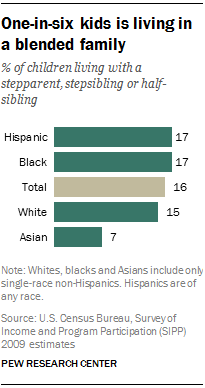 Co-ordinate to the most recent information, xvi% of children are living in what the Census Bureau terms "blended families" – a household with a stepparent, stepsibling or half-sibling. This share has remained stable since the early 1990s, when reliable data offset became available. At that fourth dimension xv% of kids lived in composite family households. All told, well-nigh 8% are living with a stepparent, and 12% are living with stepsiblings or half-siblings.12
Many, but non all, remarriages involve blended families.13 According to data from the National Center for Wellness Statistics, six-in-ten (63%) women in remarriages are in blended families, and about one-half of these remarriages involve stepchildren who live with the remarried couple.
Hispanic, black and white children are every bit likely to live in a blended family. Most 17% of Hispanic and blackness kids are living with a stepparent, stepsibling or a one-half-sibling, as are 15% of white kids. Among Asian children, however, 7% – a far smaller share – are living in blended families. This low share is consequent with the finding that Asian children are more than likely than others to be living with 2 married parents, both of whom are in their start matrimony.
The shrinking American family unit
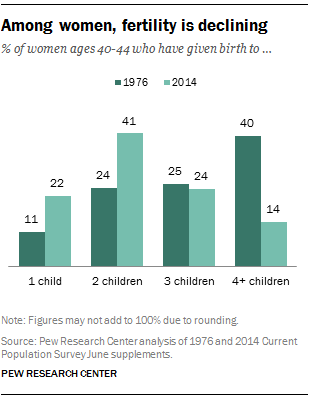 Fertility in the U.S. has been on the decline since the end of the post-World State of war Two baby boom, resulting in smaller families. In the mid-1970s, a 40% plurality of mothers who had reached the cease of their childbearing years had given birth to 4 or more than children.14 At present, a similar share (41%) of mothers at the end of their childbearing years has had two children, and merely 14% accept had four or more children.fifteen
At the same time, the share of mothers ages 40 to 44 who have had merely ane child has doubled, from 11% in 1976 to 22% today. The share of mothers with three children has remained virtually unchanged at about a quarter.
Women's increasing educational attainment and labor force participation, and improvements in contraception, not to mention the retreat from marriage, have all likely played a function in shrinking family size.
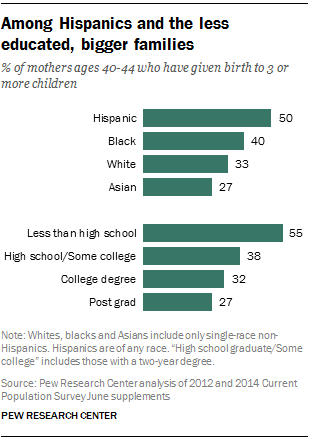 Family unit size varies markedly across races and ethnicities. Asian moms take the lowest fertility, and Hispanic mothers have the highest. Well-nigh 27% of Asian mothers and one-tertiary of white mothers near the end of their childbearing years have had three or more children. Among blackness mothers at the end of their childbearing years, four-in-ten have had three or more children, as have fully half (l%) of Hispanic mothers.
Similarly, a gap in fertility exists among women with different levels of educational attainment, despite recent increases in the fertility of highly educated women. For case, just 27% of mothers ages twoscore to 44 with a post-graduate degree such as a chief's, professional or doctorate degree have borne three or more children, as take 32% of those with a available's degree. Among mothers in the same age group with a high school diploma or some college, 38% have had three or more kids, while among moms who lack a high school diploma, the majority – 55% – have had three or more than children.
The rise of births to unmarried women and multi-partner fertility
Not only are women having fewer children today, but they are having them under different circumstances than in the by. While at i fourth dimension virtually all births occurred inside matrimony, these two life events are at present far less intertwined. And while people were much more likely to "mate for life" in the past, today a sizable share have children with more than one partner – sometimes within spousal relationship, and sometimes outside of information technology.
Births to unmarried women
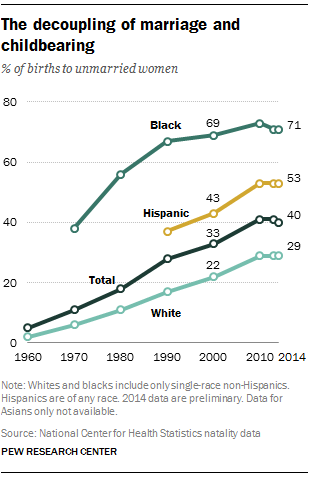 In 1960, merely 5% of all births occurred outside of marriage. By 1970, this share had doubled to xi%, and by 2000 fully one-third of births occurred to unmarried women. Non-marital births continued to ascent until the mid-2000s, when the share of births to unmarried women stabilized at around 40%.xvi
Not all babies born exterior of a union are necessarily living with just one parent, however. The bulk of these births now occur to women who are living with a romantic partner, co-ordinate to analyses of the National Survey of Family Growth. In fact, over the past 20 years, virtually all of the growth in births outside of wedlock has been driven by increases in births to cohabiting women.17
Researchers accept plant that, while marriages are less stable than they one time were, they remain more than stable than cohabiting unions. Past analysis indicates that about one-in-five children born inside a marriage will experience the breakup of that spousal relationship past age ix. In comparison, fully one-half of children built-in within a cohabiting union will experience the breakup of their parents by the same historic period. At the same time, children born into cohabiting unions are more likely than those born to unmarried moms to someday live with two married parents. Estimates suggest that 66% volition have done then by the time they are 12, compared with 45% of those who were born to unmarried not-cohabiting moms.
The share of births occurring outside of wedlock varies markedly across racial and indigenous groups. Amidst black women, 71% of births are now not-marital, equally are about half (53%) of births to Hispanic women. In contrast, 29% of births to white women occur outside of a spousal relationship.
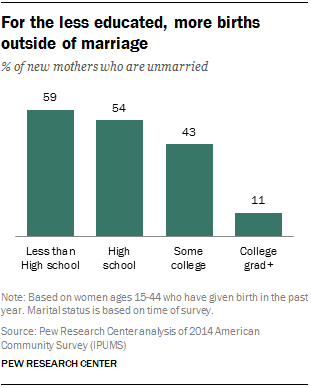 Racial differences in educational attainment explain some, but not all, of the differences in non-marital birth rates.
New mothers who are college-educated are far more than likely than less educated moms to be married. In 2014 just 11% of women with a college degree or more who had a baby in the prior year were single. In comparison, this share was nearly 4 times as high (43%) for new mothers with some college only no college caste. Virtually half (54%) of those with only a high school diploma were unmarried when they gave birth, every bit were about six-in-ten (59%) new mothers who lacked a high schoolhouse diploma.
Multi-partner fertility
Related to not-marital births is what researchers telephone call "multi-partner fertility." This measure reflects the share of people who accept had biological children with more than i partner, either within or exterior of marriage. The increase in divorces, separations, remarriages and serial cohabitations has likely contributed to an increase in multi-partner fertility. Estimates vary, given data limitations, simply analysis of longitudinal data indicates that almost twenty% of women near the cease of their childbearing years have had children past more one partner, equally accept near three-in-x (28%) of those with two or more children. Research indicates that multi-partner fertility is particularly common among blacks, Hispanics, and the less educated.
Parents today: older and meliorate educated
While parents today are far less likely to be married than they were in the past, they are more than likely to be older and to accept more education.
In 1970, the average new female parent was 21 years old. Since that time, that age has risen to 26 years. The rise in maternal age has been driven largely by declines in teen births. Today, 7% of all births occur to women nether the historic period of 20; as recently as 1990, the share was virtually twice equally high (13%).
While age at showtime nascence has increased across all major race and ethnic groups, substantial variation persists beyond these groups. The average showtime-time mom amidst whites is now 27 years former. The average age at offset birth amid blacks and Hispanics is quite a scrap younger – 24 years – driven in part past the prevalence of teen pregnancy in these groups. But five% of births to whites have place prior to age 20, while this share reaches 11% for non-Hispanic blacks and 10% for Hispanics. On the other end of the spectrum, fully 45% of births to whites are to women ages 30 or older, versus just 31% amid blacks and 36% among Hispanics.
Mothers today are as well far better educated than they were in the by. While in 1960 just 18% of mothers with infants at habitation had any college experience, today that share stands at 67%. This tendency is driven in large role by dramatic increases in educational attainment for all women. While most half (49%) of women ages 15 to 44 in 1960 lacked a high school diploma, today the largest share of women (61%) has at least some college experience, and simply 19% lack a loftier schoolhouse diploma.
Mothers moving into the workforce
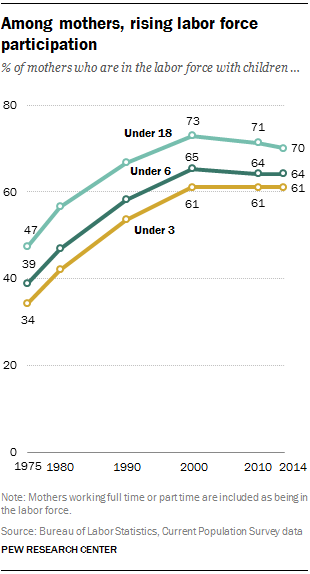 In addition to the changes in family structure that have occurred over the past several decades, family life has been greatly affected by the movement of more than and more than mothers into the workforce. This increase in labor force participation is a continuation of a century-long tendency; rates of labor force participation among married women, particularly married white women, take been on the rise since at to the lowest degree the plough of the 20th century. While the labor force participation rates of mothers have more or less leveled off since nigh 2000, they remain far college than they were iv decades agone.
In 1975, the first year for which information on the labor strength participation of mothers are available, less than half of mothers (47%) with children younger than 18 were in the labor force, and about a tertiary of those with children younger than three years old were working outside of the home. Those numbers inverse quickly, and, by 2000, 73% of moms were in the labor force. Labor forcefulness participation today stands at 70% among all mothers of children younger than 18, and 64% of moms with preschool-aged children. About three-fourths of all employed moms are working total time.
Among mothers with children younger than eighteen, blacks are the most likely to be in the labor strength –about 3-fourths are. In comparison, this share is seventy% amongst white mothers. Some 64% of Asian mothers and 62% of Hispanic mother are in the workforce. The relatively high proportions of immigrants in these groups likely contribute to their lower labor strength involvement – foreign-born moms are much less likely to be working than their U.S.-built-in counterparts.
The more than education a mother has, the more likely she is to be in the labor strength. While most half (49%) of moms who lack a high school diploma are working, this share jumps to 65% for those with a loftier school diploma. Fully 75% of mothers with some college are working, as are 79% of those with a college degree or more.
Along with their movement into the labor force, women, even more men, have been attaining higher and college levels of instruction. In fact, amongst married couples today, information technology is more common for the wife to have more instruction than the married man, a reversal of previous patterns. These changes, along with the increasing share of unmarried-parent families, mean that more than always, mothers are playing the role of breadwinner—ofttimes the principal breadwinner—inside their families.
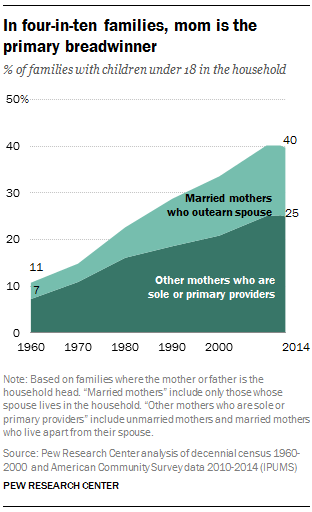 Today, forty% of families with children under 18 at dwelling include mothers who earn the majority of the family income.18 This share is up from xi% in 1960 and 34% in 2000. The bulk of these breadwinner moms—8.3 million—are either unmarried or are married and living autonomously from their spouse.19 The remaining 4.ix million, who are married and living with their spouse, earn more than their husbands. While families with married breadwinner moms tend to have higher median incomes than married-parent families where the father earns more ($88,000 vs. $84,500), families headed by unmarried mothers have incomes far lower than unmarried father families. In 2014, the median annual income for unmarried mother families was just $24,000.
Breadwinner moms are particularly common in black families, spurred by very loftier rates of single motherhood. About three-fourths (74%) of black moms are breadwinner moms. Nearly are unmarried or living autonomously from their spouse (61%), and the balance (13%) earn more than their spouse. Amidst Hispanic moms, 44% are the chief breadwinner; 31% are unmarried, while 12% are married and making more than their husbands. For white mothers, 38% are the main breadwinners—20% are unmarried moms, and 18% are married and accept income higher than that of their spouses. Asian families are less likely to have a woman as the main breadwinner in their families, presumably due to their extremely low rates of single motherhood. Just 11% of Asian moms are unmarried. The share who earn more than their husbands—twenty%— is somewhat higher than for the other racial and ethnic groups.
The flip side of the motion of mothers into the labor strength has been a dramatic decline in the share of mothers who are now stay-at-abode moms. Some 29% of all mothers living with children younger than eighteen are at home with their children. This marks a pocket-size increment since 1999, when 23% of moms were dwelling house with their children, just a long-term decline of near 20 pct points since the late 1960s when about half of moms were at home.
While the image of "stay-at-dwelling mom" may conjure images of "Leave It to Beaver" or the highly flush "opt-out mom", the reality of stay-at-home maternity today is quite different for a large share of families. In roughly three-in-ten of stay-at-dwelling house-mom families, either the father is non working or the female parent is unmarried or cohabiting. As such, stay-at-domicile mothers are generally less well off than working mothers in terms of education and income. Some 49% of stay-at-abode mothers have at virtually a high-schoolhouse diploma compared with 30% among working mothers. And the median household income for families with a stay-at-home mom and a total-time working dad was $55,000 in 2014, roughly half the median income for families in which both parents piece of work total-time ($102,400).20
lopezhatintibleat.blogspot.com
Source: https://www.pewresearch.org/social-trends/2015/12/17/1-the-american-family-today/
0 Response to "How Families Have Changed Over the Past 50 Years"
Post a Comment